Пробугарски настроен известувач чиј допис бил објавен во весникот The New York Times. Повеќе од очигледно е како во текот на написот се обидува да ја омекне и пренасочи јавноста од негативниот меѓународен однос кон Бугарија, која била на страна на губитниците од Прва Светска војна. Така што не се спротивставува на независноста на Македонија за која се залагал американскиот Претседател Вудро Вилсон, но бранејќи ги бугарските позиции, лукаво и прикриено ги претставува Македонците како состав од разни народи.
Овој напис за нас е вреден затоа што од него може да се дознаат повеќе признанија за „денационализацијата“ вршена од сите три соседни страни. Како и за меѓународната дискриминациона документациска политика согласна со политиката на победниците.
Македонски (машински)
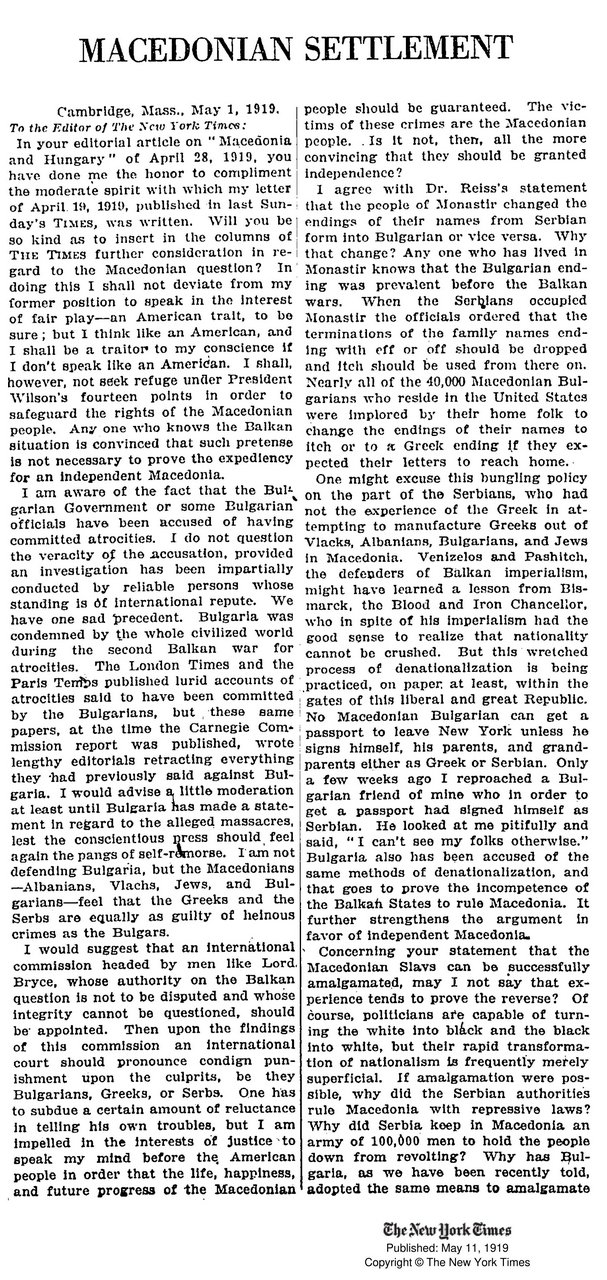
МАКЕДОНСКОТО УРЕДУВАЊЕ
Кембриџ, Масачусетс. 1 косар 1919 година.
До уредникот на „Њујорк тајмс“: Во вашиот уреднички напис на тема „Македонија и Унгарија“ од 28 април 1919 година, ми направивте чест да го пофалите умерениот дух со кој беше напишано моето писмо од 28 април 1919 година, објавено во „Тајмс“ од минатата недела. Дали би биле љубезни да вметнете во колумните на „Тајмс“ дополнителни размислувања во врска со македонското прашање? Правејќи го ова, нема да отстапам од мојот претходен став да зборувам во интерес на фер игра – американска особина, секако; но размислувам како Американец и ќе бидам предавник на мојата совест ако не зборувам како Американец. Сепак, нема да побарам засолниште под четиринаесетте точки на претседателот Вилсон за да ги заштитам правата на македонскиот народ. Секој што ја познава балканската ситуација е убеден дека таквото изговорување не е потребно за да се докаже целесообразноста за независна Македонија.
Свесен сум за фактот дека бугарската влада или некои бугарски функционери се обвинети за извршување злосторства. Не ја доведувам во прашање вистинитоста на обвинението, под услов истрагата да е спроведена непристрасно од доверливи лица чиј углед е 61 меѓународен углед. Имаме еден тажен преседан. Бугарија беше осудена од целиот цивилизиран свет за време на Втората балканска војна за злосторства. Лондон Тајмс и Париз Темпс објавија морничави извештаи за злосторства за кои се вели дека ги извршиле Бугарите, но истите овие весници, во времето кога беше објавен извештајот на Карнегиевата комисија, напишаа долги уреднички статии повлекувајќи сè што претходно кажаа против Бугарија. Би советувал малку умереност барем додека Бугарија не даде изјава во врска со наводните масакри, за да не се почувствува повторно каење од страна на совесниот печат. Јас не ја бранам Бугарија, но Македонците – Албанците, Власите, Евреите и Бугарите – сметаат дека Грците и Србите се подеднакво виновни за гнасни злосторства како и Бугарите.
Би предложил да се назначи меѓународна комисија предводена од луѓе како Лорд Брајс, чиј авторитет по балканското прашање не може да се оспори и чиј интегритет не може да се доведе во прашање. Потоа, врз основа на наодите на оваа комисија, меѓународен суд треба да изрече достојна казна за виновниците, без разлика дали се Бугари, Грци или Срби. Човек мора да се покори на одредена неподготвеност да ги каже сопствените проблеми, но јас сум принуден во интерес на правдата да го искажам своето мислење пред американскиот народ за да се гарантира животот, среќата и идниот напредок на македонскиот народ. Жртвите на овие злосторства се македонскиот народ. Не е ли тогаш уште поубедливо што треба да им се даде независност?
Се согласувам со изјавата на д-р Рајс дека луѓето од Монастир ги смениле завршетоците на своите имиња од српска форма во бугарска или обратно. Зошто таа промена? Секој што живеел во Монастир знае дека бугарската завршница била распространета пред Балканските војни. Кога Србите го окупираа Монастир, службениците наредија завршувањата на семејните презимиња што завршуваат на eff или off да се отстранат и оттогаш па натаму да се користи itch. Речиси сите од -10.000 македонски Бугари што живеат во Соединетите Држави беа замолени од нивните домашни да ги променат завршувањата на нивните имиња во itch или на грчки завршеток ако очекуваа нивните писма да стигнат дома.
Некој би можел да ја оправда оваа несмасна политика од страна на Србите, кои немаа искуство како Грците во обидот да направат Грци од Власи, Албанци, Бугари и Евреи во Македонија. Венизелос и Пашиќ, бранителите на балканскиот империјализам, можеби научија лекција од Бизмарк, канцеларот на крвта и железото, кој и покрај својот империјализам имаше здрав разум да сфати дека националноста не може да се уништи. Но, овој мизерен процес на денационализација се практикува, барем на хартија, во рамките на портите на либералната и голема Република. Ниту еден македонски Бугарин не може да добие пасош за да го напушти Њујорк освен ако не се потпише себеси, своите родители и баба и дедо како Грк или Србин. Само пред неколку недели го прекорив еден мој бугарски пријател кој, за да добие пасош, се потпишал како Србин. Ме погледна со жалење и рече: „Не можам поинаку да ги отстранам моите луѓе“. Бугарија исто така е обвинета за истите методи на денационализација, а тоа ја докажува неспособноста на балканските држави да владеат со Македонија. Тоа дополнително го зајакнува аргументот во корист на независна Македонија. Во врска со вашата изјава дека македонските Словени можат успешно да се обединат, не можам ли да кажам дека искуството има тенденција да го докаже спротивното? Секако, политичарите се способни да го претворат белото во црно, а црното во бело, но нивната брза трансформација на национализмот е често само површна. Ако обединувањето беше можно, зошто српската власт…
English OCR
MACEDONIAN SETTLEMENT
Cambridge, Mass.. May 1. 1919.
To the Editor of The New York Times: In your editorial article on ” Macedonia and Hungary” of April 28, 1919. you have done me the honor to compliment the moderate spirit with which my letter of April 28, 1919, published in last Sunday’s Times, was written. Will you be so kind as to insert in the columns of The Times further consideration in regard to the Macedonian question? In doing this I shall not deviate from my former position to speak in the interest of fair play—an American trait, to bo sure ; but 1 think like an American, and I shall be a traitor to my conscience if I don’t speak like an American. I shall, however, not seek refuge under President Wilson’s fourteen points in order to safeguard the rights of the Macedonian people. Any one who knows the Balkan situation is convinced that such pretense is not neccеssary to prove the expediency for an independent Macedonia.
I am aware of the fact that the Bulgarian Government or some Bulgarian officials have been accused of having committed atrocities. I do not question the veracity of the accusation, provided an investigation has been impartially conducted by reliable persons whose standing is 61 international repute. We have one sad precedent. Bulgaria was condemned by the whole civilized world during the second Balkan war for atrocities. The London Times and the Paris Temps published lurid accounts of atrocities said to have been committed by the Bulgarians, but these same papers, at tho time the Carnegie Commission report was published, wrote lengthy editorials retracting everything they had previously said against Bulgaria. I would advise a, little moderation at least until Bulgaria nas made a statement In regard to the alleged massacres, lest the conscientious press should feel again the pangs of self-remorse. I am not defending Bulgaria, but the Macedonians —Albanians, Vlachs, Jews, and Bulgarians — feel that the Greeks and the Serbs are equally as guilty of heinous crimes as the Bulgars.
I would suggest that an International commission headed by men like Lord Bryce, whose authority on the Balkan question is not to be disputed and whose integrity cannot be questioned, should be appointed. Then upon the findings of this commission an International court should pronounce condign punishment upon the culprits, be they Bulgarians, Greeks, or Serbs. One has to subdue a certain amount of reluctance In telling his own troubles, but I am impelled in the interests of justice to speak my mind before the American people in order that the life, happiness, and future progress of the Macedonian people should be guaranteed. The victims of these crimes are the Macedonian people. Is it not, then, all the more convincing that they should be granted independence?
I agree with Dr. Reiss’s statement that the people of Monastir changed the endings of their names from Serbian form into Bulgarian or vice versa. Why that change? Any one who has lived In Monastir knows that the Bulgarian ending was prevalent before the Balkan wars. When the Serbians occupied Monastir the officials ordered that the terminations of the family names ending with eff or off should be dropped and itch should be used from there on. Nearly all of the -10,000 Macedonian Bulgarians who reside in the United States were implored by their home folk to change the endings of their names to itch or to a Greek ending if they expected their letters to reach home.
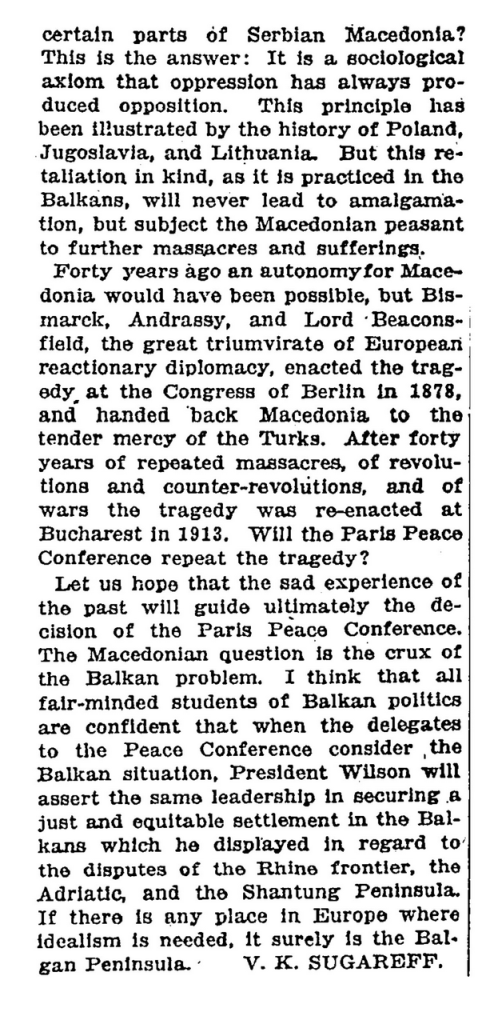
One might excuse this bungling policy on the part of the Serbians, who had not the experience of the Greek in attempting to manufacture Greeks out of Vlacks, Albanians, Bulgarians, and Jews in Macedonia. Venizelos and Pashitch, the defenders of Balkan imperialism, might have learned a lesson from Bismarck, the Blood and Iron Chancellor, who in spite of his imperialism had the good sense to realize that nationality cannot be crushed. But this wretched process of denationalization Is being practiced, on paper at least, within the gates of tills liberal and great Republic. No Macedonian Bulgarian can get a passport to leave New York unless he signs himself, his parents, and grandparents either as Greek or Serbian. Only a few weeks ago I reproached a Bulgarian friend of mine who in order to got a passport had signed himself as Serbian. He looked at me pitifully and said, ” I can’t sea my folks otherwise.” Bulgaria also has been accused of the same methods of denationalization, and that goes to prove the incompetence of the Balkan States to rule Macedonia. It further strengthens the argument in favor of independent Macedonia. Concerning your statement that the Macedonian Slavs can be successfully amalgamated, may I not say that experience tends to prove the reverse? Of course, politicians are capable of turning the white into black and the blackinto white, but their rapid transformation of nationalism is frequently merely superficial. If amalgamation were possible, why did the Serbian authorities rule Macedonia with repressive laws? Why did Serbia keep In Macedonia an army of 100,000 men to hold the people down from revolting? Why has Bulgaria, as we have been recently told, adopted the same means to amalgamate certain parts of Serbian Macedonia? This is the answer: It is a sociological axiom that oppression has always produced opposition. This principle has been illustrated by the history of Poland, Jugoslavia, and Lithuania. But this retaliation in kind, as it is practiced in the Balkans, will never lead to amalgamation, but subject the Macedonian peasant to further massacres and sufferings.
Forty years ago an autonomy for Macedonia would have been possible, but Bismarck, Andrassy, and Lord Beaconsfield, the great triumvirate of European reactionary diplomacy, enacted the tragedy at the Congress of Berlin In 1878, and handed back Macedonia to the tender mercy of the Turks. After forty years of repeated massacres, of revolutions and counter-revolutions, and of wars the tragedy was reenacted at Bucharest in 1913. Will the Paris Peace Conference repeat the tragedy?
Let us hope that the sad experience of the past will guide ultimately the decision of the Paris Peace Conference. The Macedonian question is the crux of the Balkan problem. I think that all fair-minded students of Balkan politics are confident that when the delegates to the Peace Conference consider the Balkan situation. President Wilson will assert the same leadership in securing a just and equitable settlement in the Balkans which he displayed in regard to the disputes of the Rhine frontier, the Adriatic, and the Shantung Peninsula. If there is any place in Europe where idealism is needed, it surely is the Balkan Peninsula. V. K. SUGAREFF.
Published: May 11.1919 Copyright © The New York Times
Посочил: Ѕале
